mollyringle: (Default)
 Are you still following me here and seeing this? Thank you! That is really nice of you! And also, please understand I'm barely ever here on LJ anymore. I miss you and I do want to stay connected with you, though! So, find me elsewhere—pick a couple of these:

Tumblr: https://www.tumblr.com/blog/mollyringle

Bluesky: https://bsky.app/profile/writermollyringle.bsky.social

My mailing list: https://mollyringle.us20.list-manage.com/subscribe...

Instagram: https://www.instagram.com/writermollyringle/

Substack: https://substack.com/@mollyringle 

TikTok: https://www.tiktok.com/@writermollyringle  

As thanks, here is a cute picture of my dog in the tub.

A very wet corgi

mollyringle: (Default)
 As a fandom-loving person, one of my favorite sites at which to go down rabbit holes (that saying itself being a fandom reference, of course) is TVTropes.org. Despite its name, it does not confine itself to TV shows, but encompasses all of popular culture: video games, literature, music, theatre, anime, you name it. It has accurate and often amusing names for the over 30,000 (!) tropes listed on the site, and it cross-references each one with the books, shows, etc., that contain examples of the trope. It is fantastic fun, and I can easily lose an hour there anytime.

(A quick sidenote before we continue: Tropes are not a bad thing. You’re thinking of clichés. Those are to be avoided. Tropes, however, are storytelling conventions. As TV Tropes puts it, “tropes are tools that the creator of a work of art uses to express their ideas to the audience. It's pretty much impossible to create a story without tropes.”)

Today I was browsing the site for examples of the tropes in my own books, and found a good basic one on The Fair Folk.

As usual, TV Tropes knows what's up! Their entry is spot-on for what I have learned in reading about the fae, and is more or less what I show in the Eidolonia books (Lava Red Feather Blue, and the upcoming Ballad for Jasmine Town), as well as The Goblins of Bellwater, which isn't set in Eidolonia but has a similar system.

Excerpt from TV Tropes:

"The fairies of old weren't cute little bewinged pixies who fluttered happily around humans. ...Often, they would interact with humans with no thought to the consequences of their actions, or they would be tricksters that deliberately delighted in the utter mess they made of mortal lives.... At worst, they're like serial killers with magic.

"...There actually were plenty of myths and folklore about fairies who helped humans, though they were still believed to be dangerous if angered— but then again, the belief that supernatural beings are helpful to humans that show them kindness and angry if neglected is ubiquitous in many traditional religions and folk beliefs, including Greek Mythology."

I, too, have noticed the remarkable similarity to the Greek gods, in the diverse personalities, powers, and whims of the fae. No wonder I was drawn to write about both.

mollyringle: (Default)
Couple of announcements:
First, an LJ one. I can no longer access my mollyringwraith LJ. I did not lose the password; I am a good password steward and I still had it! But when I tried to get in the other week after hearing it was subject to a security hack, LJ helpfully told me the password was too old and I had to change it. Which you can only do by email verification. And the email never arrived, so probably LJ had a defunct email of mine as the contact. And their FAQ says there is no other way to recover access if the above process doesn't work. So. That is now closed to me. It might get purged by LJ; I don't know. Copy and save any posts you want to keep from it.

Other announcement:
I am mostly letting my Goodreads account go dormant, as I am tired of the toxic atmosphere there. I’m going over to Storygraph instead. Find me under mollyringle and send me a friend request! I am new there and barely have anyone added yet.

When someone saw my post on GR that announced the above, they asked, in all innocence, “Why do you find Goodreads toxic?”

Here is my answer, and know that this is the short version and I could go on and on:
The worst is the cruel, snarky tone of many of the negative reviews. They often go beyond "what didn't work for me" and well into scathing, hateful rants.

Then, the site lets you upvote reviews, so people may like those snarky ones because they find them funny, but those who disagree or find them unhelpful have no way to downvote them. So such reviews often float to the top and are the first ones people see for the book.

Also, Goodreads puts the star ratings front and center, and sometimes the mere number rating is enough to turn people off from trying a book.

And finally, Goodreads is now owned by Amazon, which has not proven itself a great friend of the publishing trade on the whole. (That’s a whooooole other long post that I don’t feel like writing. But google it if you’re curious. Lots of publishers, authors, and industry pros have spoken on the subject.)

Storygraph, meanwhile, tucks away star ratings and reviews discreetly—you have to scroll a bit to find them at all—instead putting focus on the book’s genres, subgenres, tone, style, and pacing. It also, true to its name, makes some really cool graphs and charts of your reading habits once you’ve entered the books you’ve read.

And: yes! You can import your Goodreads reading history into Storygraph. It wasn’t hard for me to do at all. (You can google that too. That’s what I did.) So please find me there! We all deserve a calmer and less toxic reading discussion experience.
mollyringle: (Default)
It's been too long since I've brought on another author for Q&A, and I'm pleased to be doing so again with Darlene Foster! I met Darlene (in an online sense) through our publisher in common, Central Avenue Publishing, and she's one of the most upbeat, easygoing, fun-loving writers I know. Her Amanda Travels series is a wonderful set of books for middle-grade readers in which the young Amanda visits a new country in each book and always encounters an adventurous mystery to untangle. They're perfect for the young armchair traveler—or real-world traveler—in your life.

Author Darlene Foster

The eighth book in the series comes out this May: Amanda in Malta: The Sleeping Lady. I got to read an advance copy of it, and was instantly longing to go to Malta and soak up the sun and stroll between the stone buildings with their artistically idiosyncratic door knockers! 

Cover of Amanda in Malta: The Sleeping Lady


Darlene was kind enough to answer some questions for me as well, so let's dive into those:

Q: When did you start writing fiction? What were your earliest stories like?

A: I’ve been telling stories since I learned to talk. My grade three teacher, Miss Roll, encouraged me to write them down. When I was twelve years old I had a short story published in a local newspaper. Called Stretch Your Food Dollar, it was about two friends having an adventure in Woolworths department store. I guess the idea of two girls having an adventure has been there for a long time! 

Q: When you visit places, how much are you thinking about a possible story while you’re there? Or does the story idea come later?

A: When I visit interesting places, I am always thinking about how I could use it in a story. When I was in Malta, I kept saying to my husband, “Amanda would love it here!” I take a lot of pictures and jot down notes wherever we go. I once read that a writer never really takes a vacation as they are always looking for story ideas. I can attest that is true.  

Q: What draws you to writing middle-grade fiction as opposed to stories for other age groups?

A: Some would say I have never moved past twelve myself! For some reason, I can easily relate to this age group. I think they are wonderful. Tweens are not little kids anymore but not yet terrible teenagers. They can be so astute and mature at times but still naïve and unsure of themselves at other times. It is the age when they start to assert their independence and become curious and questioning. It is my favourite age and I have no intention of growing up. 

Q: I admire Amanda’s fearlessness and willing to take on adventures. Is that what you were like at her age?

A: It wasn’t what I was like, but it was what I wished I was like. I lived on a farm and we didn't travel or have a television. So my world was very narrow. I was timid, bookish, and the only adventures I had were in my imagination. So I created a character I would have liked to be. 

Q: Give some advice to the aspiring travelers of the world: what are your must-bring items that lend to happier traveling?

A: The most important thing to bring is an open mind. Accept that things will be different wherever you go, the food, smells, people, climate, customs, etc. Embrace those differences and you will have an enjoyable and enriching time. Also bring a camera, a notepad, and pen. Everything will be overwhelming and you will never be able to remember it all. Pictures and notes bring it all back. I would rather look at my travel photos than watch TV. 

Q: What are you writing now, or planning to write next?

A: I am halfway through writing Amanda in France: Fire in the Cathedral. Amanda will fall in love with Paris, Versailles, and Monet’s garden in Giverny. Oh, and she will get to stay in a bookstore! Wouldn't every young girl like to visit France? I know I would have loved it.  

----

Darlene Foster is a Canadian author who has written the popular Amanda Travels series, featuring a spunky twelve-year-old who loves to travel to unique places where she encounters mystery and adventure while learning about another culture. Readers of all ages enjoy travelling with Amanda as she unravels one mystery after another in various countries. Darlene has won prizes for her short stories and a number of them have been published in anthologies. She has also written a bilingual book for English/Spanish readers.

Darlene grew up on a ranch near Medicine Hat, Alberta, where her love of reading inspired her to travel the world and write stories. Over the years she held wonderful jobs such as an employment counsellor, ESL teacher, recruiter, and retail manager, and wrote whenever she had a few spare minutes. She is now retired and has a home in Spain where she writes full time. When not travelling, meeting interesting people, and collecting ideas for her books, she likes to spend time with her husband and entertaining dog, Dot.

Her books include Amanda in Arabia: The Perfume Flask, Amanda in Spain: The Girl in The Painting, Amanda in England: The Missing Novel, Amanda in Alberta: The Writing on the Stone, Amanda on The Danube: The Sounds of Music, Amanda in New Mexico: Ghosts in the Wind, and Amanda in Holland: Missing in Action. 

All of the published books by Darlene Foster in the Amanda Travels series

Amanda in Malta: The Sleeping Lady will be released in the spring of 2021. 

Buy links

Amazon Canada here

Amazon UK here 

Amazon US here 

Barnes and Noble here

Chapters/Indigo here

You can connect with Darlene on social media at the links below:

Facebook
Twitter
Instagram
LinkedIn
Goodreads

mollyringle: (Default)

I haven't posted here about the new book, have I? Here is its magnificent cover!

 
Cover of Lava Red Feather Blue by Molly Ringle: mountains, starry sky, jewels, trees 

All of you who love the idea of a m/m Sleeping-Beauty-inspired urban fantasy set in a fictional island country full of fae and witches: please go request it on NetGalleypreorder it (release date is January 5, 2021), or just put it on your Goodreads shelves to remind yourselves later.

This was the first time I've invented an entire new country for a story, so that was especially fun. I'll probably write more books set on this island, now that I've gone to the trouble of building it.

That is all. Hope you are all as well and sane as is reasonably possible in a year like this one. 

mollyringle: (Default)
All the Better Part of Me is officially available worldwide! It was a long wait, and I hope you enjoy it if you're just now picking it up.

Also, this means Amazon is now allowing people to leave reviews. So if you have already read the book and loved it, please do review it on Amazon! (And for that matter on Barnes & Noble and any other bookselling site you enjoy, if you want to go above and beyond.) If you didn't love it, feel free to take no particular action. ;)

I'm especially excited that the audiobook edition is also out! It can be found via Audiobooks.com or Audible, and you might even find it in your local library's Hoopla collection. I've begun listening to it and am happily grinning at narrator Alex Kydd's delivery of various lines.

If you prefer video,
I gave a book talk at Third Place Books Ravenna, in Seattle, last Friday, and it is now up on YouTube. I'm pleased to find that Third Place has flattering lighting, unlike some stores.

And finally, in further marketing madness, here are a couple of articles I've contributed to lately:

One in which I discuss how the main character of All the Better Part of Me got me hooked on the band the Cure, hosted at blog of author Roberta Blablanski.

And a Q&A from author Pam Stucky in which I discuss the problem of bi erasure, among other things. Come check it out if you don't know what that is, or if you do know what it is and want to make sure I got it right. (I welcome further education if I didn't.)

Whew. I think that catches us up, book-release-wise. Carry on and happy September.


mollyringle: (Default)
When it comes to historically significant fairy tale writers, you've heard of the brothers Grimm, Hans Christian Andersen, and maybe even Charles Perrault, but have you heard of Marie-Catherine d'Aulnoy? Writing at the same time as Perrault, she composed and adapted traditional fairy tales, retelling them in literary style to publish and share at salon gatherings. She was in fact the one credited with popularizing the term "fairy tales": "contes des fées."

She was forced into an unhappy marriage at age fifteen, tried to get revenge a few years later by conspiring to have her husband imprisoned, and, when that failed, was forced to flee France for many years, although according to Wikipedia she MAY have worked as a spy for France while living abroad.

Upon returning, she charmed her way back into good social standing with her romantic contes des fées, "where love and happiness came to heroines after surmounting great obstacles." And she ought to know about those things.

Raising my cup of coffee to you today, Madame.

https://en.wikipedia.org/wiki/Madame_d%27Aulnoy
mollyringle: (Default)
 

In her books about happiness and habits, writer Gretchen Rubin describes the Four Tendencies, the personality framework she created. I realized in studying them that these tendencies are not only a fabulous way to learn about ourselves and our friends, but to flesh out our fictional characters too.


Brief description of the Four Tendencies:


Upholders are people who respond readily to both outer and inner expectations; that is, expectations from others as well as expectations they set for themselves.

Questioners are people who meet inner expectations, but question outer expectations; they’ll meet others’ expectations only if they think they make sense.

Obligers are people who meet outer expectations, but struggle to meet expectations they impose on themselves.

Rebels are people who resist all expectations, outer and inner alike, but can do nearly anything they truly want to.


Since this framework deals with people’s response to goals, it’s related closely to motivation—which, as every fiction writer knows, is crucial in understanding characters. What are we advised to decide right away for every main character in every scene? Their goal, their motivation. Thus knowing your character’s Tendency will help you know how well they will perform under various challenges.


Is your character’s goal imposed by another person, such as an assignment a teacher gives a student? A student who is an Obliger or an Upholder will dutifully do the assignment even if they don’t like it. A Questioner will ask herself if she has a good enough reason for doing it, and if so (for instance, if getting good grades is important to her), she’ll buckle down and complete it. A Rebel might have trouble getting around to it even if he means to—or, conversely, might have no trouble doing it if he decides that writing this essay is what he wants to do, but he’ll probably bend or break some of the instructions in the assignment.


Or is the goal an inner expectation, such as the resolution to find a new job by the end of the month? In a situation like this, Questioners and Upholders have no trouble sticking to their self-appointed task. Obligers, meanwhile, find it hard to follow through unless someone else is counting on them—for instance, if their family needs the money and it’s therefore important that they find work. As for Rebels, there’s no counting on them unless they’ve hit upon a job that calls out to them and they’re determined to do it, at which point nothing will stop them. Expecting a Rebel to meet someone else’s meticulously laid out job qualifications, however: don’t bet on it!


Once I decided, in my latest novel-in-progress, which Tendencies my main characters belonged to, it helped me see their strengths and flaws more clearly, and thereby made it more obvious what their overall character arc should be. An Obliger might have to learn to break free from the burdensome expectations laid on him by others and stand his own ground. A Rebel might have to learn to shoulder more responsibility for her actions and take fewer reckless risks. A Questioner might have to learn to trust someone else and take a leap of faith. An Upholder might need to learn to loosen up and let his plans change.


Rubin and the contributors commenting on her blog have come up with examples of the Four Tendencies among famous fictional characters. Hermione Granger is a textbook Upholder, turning in every bit of homework on time as well as doing extra assignments she chose for herself. Jane Eyre is a Questioner, not accepting the rules of others until she has thought things through to her own satisfaction—in fact, on the first page of the book, her disapproving aunt calls her a “questioner.” George Bailey in It’s a Wonderful Life is an Obliger, always tending to everyone else’s needs, sometimes at the expense of his own goals. And Sherlock Holmes is a Rebel, doing exactly what he wants, when he wants, with brilliance and total disregard for other people’s rules and expectations.


How about your characters? Which Tendency do they follow, and how does this illuminate the actions they’re likely to take?


You can take Rubin’s quiz here to find out your own Tendency or that of your characters.


As for me, I’m a Questioner. My thought when that answer came up was, “Hmm, I don’t know, I really thought I was an Upholder. I question the…oh.”


mollyringle: (Default)
 Hello all,

I have been not getting a lot of work done lately, since our household was on vacation for two weeks in England and Wales! I had not been there since 2004 and it was fabulous to be back, despite the heat wave. (Luckily a "heat wave" in Britain only means temperatures around 85 F/ 29 C. Still, I would have preferred a bit of iconic British rain or mist.) 

If you're the kind of person who enjoys trip photos, I spammed Instagram with mine:

https://www.instagram.com/writermollyringle/

At this point you'll have to scroll down a little to get to the Britain ones, but I'm sure you'll be able to find them. For those unfamiliar with Instagram: you then click on each one to bring up the post, and click on the arrows on the photo itself (not on the edges of the window) to see the other photos in that post.

Nonetheless, writing work does progress: 

The audiobook for Summer Term is in production and should be ready in a few weeks. 

I should also be having more editorial discussions about Dramatically Inclined in the fall, and will keep you informed on news there too. Part of that story takes place in London, which made me especially happy to see that city again in person!

And I'm deep into the writing of my next book, which involves fae and royals and a fictional country and a male/male love story, and I'm quite taken with it at the moment.

For now, feel free to retaliate with your own vacation photos--after all, I need ideas for where to go in future years.
Take care and enjoy the summer!

mollyringle: (Default)
We’re down to the final edits of The Goblins of Bellwater, and those proofing it have pointed out that I need to pick what the singular of “fae” is. I mostly have gone with “faery,” though slipped into “faerie” a time or two. Or hang on, should it just be “fairy”?

Well. Not a straightforward “check the dictionary, duh” kind of question, it turns out. Merriam-Webster and others simply list “faery” and “faerie” as “less common” or even “obsolete” variants of “fairy.”

The word comes from Old French “faerie” and “fae,” leading to Middle English “fairie” (oh look, another variant) which became Modern English “fairy.” So yes, in a sense, the modern version is spelled “fairy,” as the dictionary says. However. Connotations must be taken into account.

First problem I have with “fairy”: it makes people think of the Disney style of fairy. Glittery pink wings, giggling, sanitized, harmless, a cute party costume for five-year-olds. This isn’t the kind of fairy I’m writing about.
Second problem I have: “fairy” has become derogatory slang for a gay man, which is both distracting and a mean-spirited kind of attitude I want no part of.

As someone puts it on this language discussion forum, “fairy tales and the associated idea of fairies typically refer to the genre of folk stories printed by the Brothers Grimm, then sweetened and popularized for modern audiences by Disney et al. Faerie stories, on the other hand, are stories about the fae: otherworldly, unpredictable, and dangerous creatures who appear in the folk-tales and myths of England and Ireland. In origin, of course, the fairies and the fae are one and the same, but the connotations and usage of the words today are headed in opposite directions.”

I like the spelling “faerie,” even though it gets marked “archaic or poetic” by the dictionaries, and sometimes even “pseudoarchaic”—ooh, no one wants to be called that! Feeling the lexicography burn, Edmund Spenser? (With The Faerie Queene, from 1590, Spenser apparently used a deliberately archaic spelling.) But “faerie” also has the complication that it sometimes refers to fairyland, the realm of Faerie, rather than an individual being.

So: “faery,” then?
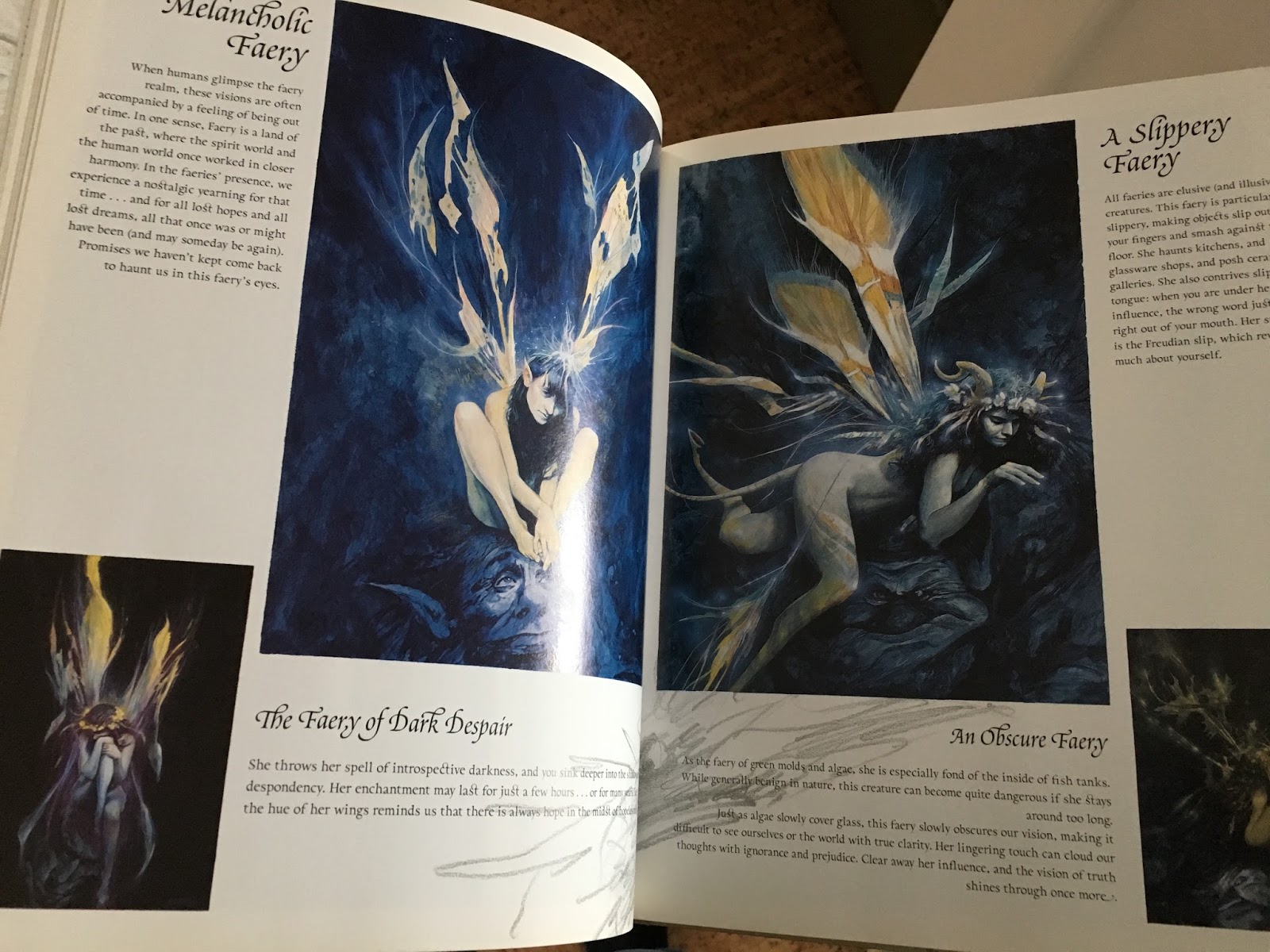
Much of my visual idea of the kind of fae I’m writing about comes from the brilliant, gorgeous artwork of Brian Froud—whose most influential volume on the subject is of course titled Faeries. In his own writing about them, he spells it “faery” for singular, so really, if Brian Froud calls them that, it’s good enough for me.

Exhibit A: page from Froud’s 
Good Faeries, Bad Faeries:


That said, Froud seems to prefer “the faeries” as the plural, whereas I’ve fallen into the habit of “the fae,” just because I like it. Plenty of others use “the fae” too, just not Froud so much.

Thus I’m going with “faery,” but in case anyone ever asks, yes, I know it’s an imperfect solution, and I know some people will call me pseudoarchaic. I’m feeling the burn. 
mollyringle: (unexplained pirates - songstressicons)

Just in case we all decide to abandon LJ, here are some other places you are welcome to find/follow me...

I've been backing up this LJ here at Blogspot for a few years now. Suppose that will become my main blog if I ever choose to delete this one. (I have no plans to at the moment, but there you go, just in case.)

I am on Instagram now as well, just for fun and pretty pictures.

I have a Facebook author page though I continue to despise Facebook for so many, many reasons.

I'm on Twitter and also Tumblr (Tumblr sometimes gets my posts as well, and/or other fun stuff, though I'm inconsistent about that).

There's also Goodreads, for book discussion.

Yeah, really, there are options to LJ, now that I think about it. ;)

mollyringle: (Gutenberg)

This month Persephone's Orchard is a free download as an ebook (see Amazon, B&N, Kobo, and other sites too), and I've been contributing guest posts on my take on Greek mythology to many lovely book bloggers to help spread the word.

Since the posts are fun and brief and a nice diversion from the news, here's a roundup of them for anyone interested:

10 Things I Like About Persephone. E.g., "She has an interesting marriage story..."

10 Things I Like About Hades. For one: "He does not have blue flames for hair. No one except Disney has ever said so, and they are making things up."

"No one ever knows about all my cats": The Inscrutable Divine Trickster Hermes. "Yes, he’ll screw you over sometimes and drive you crazy. But he’ll also surprise you with unexpected gifts."

It's always the right time to immerse ourselves in good books, and it can be especially therapeutic in stressful eras. Hope you are all finding time to read something excellent!

mollyringle: (iPod)

It has come to my attention today that I've been included in an AP article being picked up all over the country. It's not about my writing, my books I've spent years creating, NO, OF COURSE NOT. It is, like last time, about a moment of online frivolity, and, once again, is not representing my original post quite accurately.

The article this time is about whether "ballot selfies" are legal (answer: depends on the state), and they include a few tweets from those of us who posted a photo on Twitter with the #ballotselfie hashtag. This was mine:

\

And you will kindly notice, if you have eyesight, that my ballot is EMPTY in that photo. I would not go posting my filled-in ballot. That's just tacky. Nonetheless, some of the versions of the article, such as this one, say stuff like, "They're posting selfies on social media with their completed ballots," followed directly by the link to my tweet. UGH. NO I AM NOT. Would you LOOK before writing the article, please.

What was the other time I made the rounds in an AP article, you ask? That was back in 2010 when I won the Bulwer-Lytton Fiction Contest with one silly sentence, and was rewarded with headlines calling me a bad writer, because too many people do not understand the BLFC. (i.e., Those sentences are not from actual published books; they are all one-offs, written to be deliberately bad, for fun, by language-loving people with a bizarre sense of humor.)

But, in any case: go vote, my fellow Americans.

mollyringle: (Avatar)

Writing inspiration I heard today, from Neil Gaiman, talking to Elizabeth Gilbert on her Magic Lessons podcast:

"Audiences, fans, only ever want one thing, which is more of what they liked last time. And it is your job as an artist not to give that to them. 'Cause what you have to give them is what they don't know they want yet."

I love this and I agree, because I like to write things that don't entirely conform to genre guidelines. But of course I instantly thought of all those really successful writers who do turn out book after book of basically what the audience liked last time. And they seem happy, and the readers seem happy. Well, Neil talked about them right away too:

"There are dolphins and there are otters. ...The dolphin will come up, it will stand on its tail, it will do a somersault...and that's great... A dolphin will put on a dolphin show. The reason why there are no otter shows... the problem with an otter is if you get an otter to do a trick, and you give it a fish, the otter goes, 'Okay, that was fun,' and next time it'll do something completely different. Because why would you do the thing you just did again? Training otters is always a complete failure because what they want to do is the next thing. They don't want to do the thing they just did, and they definitely don't want to do it over and over again."

He acknowledges he's an otter (Liz Gilbert says she is too), and so am I; and they hasten to add (as do I) that we aren't demeaning the dolphin types here. We actually really admire them, and of course publishers love them. Publishers are less sure about what to do with otter types like me. They want us to find a niche, become a brand, be a reliable source of This Type of Book--like the dolphins. But even having written fiction for, gosh, over 25 years now, I've never been able to define what my type of book is. Because I like to do new things. I'd get unhappy and boxed-in if with each book I did more or less the same thing as last time.

I mean, I kind of have a signature style. I always have a love story, so in every book, I do bring characters together, drive them apart with obstacles, and put them together again. And I always deploy humor, at least in occasional scenes if not in a full-on comedy genre kind of way. (Though sometimes I go all the way into full-on comedy.) But some of my stories are paranormal and some are real-world. Some are modern, some take place long ago. In some books the central issues are life-and-death, while in others they only crest as high as relationship implosions. And even with the love stories, I like variety, which is probably part of why I love bringing in LGBTQ characters--lots more possibilities! Yay!

Publishers can count on dolphin types for their consistent work. They can't count on me or other otters for consistency. But they can count on this: if we don't write what we want to write, we won't be happy. And if we aren't happy, our work won't turn out as good. So, it's a bit of a gamble, taking us on. We know and we apologize. But maybe we'll end up giving readers what they didn't know they wanted, and then everyone wins.

mollyringle: (moon over ocean)

I recently had the pleasure of reading a new YA male/male love story called Caught Inside in advance of its release--see my glowing review here.


The novel's summary:

Luke believes he has his life figured out…and then he meets Theo.

It should have been simple—a summer spent with his girlfriend Zara at her family’s holiday cottage in Cornwall. Seventeen-year-old Luke Savage jumps at the chance, envisioning endless hours of sunbathing on the private beach and riding the waves on his beloved surfboard. He isn’t interested in love. Though his rugged good looks and lazy charm mean he can have his pick of girls, he has no intention of falling for anyone.

Nothing prepares Luke for his reaction to Theo, the sensitive Oxford undergraduate who is Zara’s cousin and closest friend. All at once, he is plunged along a path of desire and discovery that has him questioning everything he thought he knew about himself. No one, especially Zara, must find out; what he and Theo have is too new, too fragile. But as the deceit spirals beyond their control, people are bound to get hurt, Luke most of all.

---

And today, author Jamie Deacon has answered some interview questions for me! Check them out:

MR: I loved the setting and now I long to visit Cornwall. What is your connection/history with the area?

JD: Oh, I’m so glad I’ve inspired you to visit the West Country. It’s a beautiful part of the world. I was lucky enough to enjoy many family holidays in Cornwall whilst growing up, and it’s a place that’s close to my heart. And of course the Cornish coast is a hotspot for surfers, so it would naturally appeal to my hero!

MR: What are your favorite types of scenes to write? And what are the hardest?

JD: I must have a taste for the dramatic, because I love writing scenes with a lot of angst, something which probably won’t surprise readers of Caught Inside. Opening scenes are the hardest for me, I think. Finding the best way to introduce readers to the story and characters can be a challenge. In fact, I’ve lost count of the number of times I rewrote the first chapter of Caught Inside.

MR: Is there a genre you haven’t written yet but would like to try? How about a genre you’ll probably never write?

JD: LGBT stories are my passion, and I also can’t imagine writing outside young and new adult fiction. There’s something about YA and NA, the rawness of the emotion, how the characters are just discovering themselves and what they want in life, that really appeals to me. I’d definitely like to try my hand at something other than contemporary, though. I have an outline for a romantic suspense trilogy set in a prestigious art college, and even a tentative idea for a novel with a fantastical twist.

MR: What elements do you especially like to include in a love story?

JD: Lots of obstacles. I love tender moments and happy endings, but for me these are all the sweeter and more satisfying when the protagonists have had to work hard to get there.

MR: I must ask: are you a surfer? The descriptions of the sport in the book seemed realistic to me, but then, I’ve never really tried it!

JD: Hahahaha! No, I’m not a surfer. Like Zara, Luke’s girlfriend in Caught Inside, my balance is atrocious. The closest I’ve ever come to the sport is water-skiing, and it’s fair to say I spent far more time in the water than on it. I’m thrilled that my portrayal of surfing came across as authentic, though. It was really important to me to capture Luke’s passion, and I did a ton of research in an attempt to get it right.

MR: What are you working on now, and/or planning to write next?

JD: I’m currently writing Forbidden Steps, the second novel in my Boys on the Brink series. This one deals with a fledgling step family and all the tensions and conflict that so often results when two families are dismantled, then pieced back together to form something entirely new. The fact that my heroes are stepbrothers who fall in love only adds to the drama! In the meantime, a short story of mine will be appearing in an anthology of NA m/m romances about taking chances, due for release later this year.

---

I am looking forward to those new stories, for sure! In the meantime, connect with Jamie:

Website
Facebook
Twitter
Goodreads
Boys on the Brink Reviews


Jamie lives in a tranquil spot close to the River Thames in Berkshire, England, and has always been just a little out of place—the only redhead in a family of brunettes; an introvert far more at ease with dogs than with people; a connoisseur of simple pleasures in a society intent on the quest for wealth and fame. Despite an outward cynicism, Jamie is a romantic at heart, and, when not immersed in a book, can mostly be found writing emotional stories where young men from all walks of life are thrust headlong into the breathless, euphoric, often painful whirlwind called love.

Get Caught Inside at:

Beaten Track Publishing
Amazon
Barnes & Noble
iTunes
Kobo

mollyringle: (Froud - bad faeries)

Today I'm excited to welcome back author Kaitlin Bevis, who, like me, loves writing Greek-mythology-based stories. And she has a new book coming out soon! Love and War, the latest in her Daughters of Zeus series, will be released on Oct. 21, and you can preorder it now. Read all about it here, and check out an excerpt too, and dang is that a gorgeous cover or what?

---

After narrowly escaping with her life, Aphrodite wakes up to find herself at the demigods’ base camp—a gorgeous tropical island. Powerless and injured, she has no choice but to glamour herself as a demigoddess in order to find out what’s really going on. Lucky for her, she’s not alone. Ares is with her, also in disguise. But she soon realizes she might be more of a liability than an asset when her panic attacks and nightmares threaten to expose them both.

Ares is as anxious as anyone to shut down the demigods’ plot. But right now, all he can think about is Aphrodite. He almost killed her, for Gods’ sake! And though the timing couldn’t be any worse, he’s falling hard and fast. He’ll do anything to protect her . . . even if it means sacrificing himself.


Still, they find allies in the most unexpected places . . .

More goddess than demigoddess, Medea is married to the rebel leader, Jason. But there’s something odd going on. Jason is acting very strange, and Medea finds herself drawn to a new demigoddess who mysteriously arrived on the island half-dead. She senses there’s more to this visitor than meets the eye. Little does she guess . . .

War is coming, there’s no doubt. But, in her weakened state, does Aphrodite have any hope of surviving it?


Read an excerpt here!

Read more... )

---

Kaitlin Bevis spent her childhood curled up with a book and a pen. If the ending didn't agree with her, she rewrote it. Because she's always wanted to be a writer, she spent high school and college learning everything she could to achieve that goal. After graduating college with a BFA and Masters in English, Kaitlin went on to write The Daughters of Zeus series.

mollyringle: (moon over ocean)

I'm happy to be able to liven up this Monday by bringing back Kaitlin Bevis, author of the Daughters of Zeus series! We've been talking about our Greek myth series and the different ways we've handled the characters of the gods, so here she is on this week's topic. Welcome, Kaitlin! Take it away...

---


Last time I was a guest on this blog, I touched on the surprising similarities between the characters in my Daughters of Zeus series and Molly Ringle’s Chrysomelia Stories Series. Today, I’d like to talk about two characters who couldn’t be more different.

Poseidon and Ares.

Now, there were no saints in the Greek Pantheon. To create a sympathetic character for a retelling there are some major things that the writer either needs to reframe or just ignore. The characters of Poseidon and Ares in both of our books are great demonstrations of that in action on both sides of the concept.

Take Poseidon for instance. In Mythology Poseidon could be benevolent to his followers. His myths inspired the kind, thoughtful, fun god we see in Molly’s series (adorably portrayed by Liam, who funnily enough, reminds me of my Triton), Rick Riordan’s series, and more.

Myths also portray him a violent rapist with control issues and a mercurial temper. Which is more reflective of my Poseidon.

In both my story and Molly’s, there’s something deeper beneath the surface. Both of our Poseidon’s are driven by complex motivations and strong beliefs. We just let them drive our characters in different directions.

Ares is an example where I looked the other way. In mythology, Ares was rash and violent. He had a reputation for being blood thirsty. In Roman Mythology a rape committed by him set the entire empire into motion.

But my Ares is very much a sympathetic love interest. The second generation gods in my books are almost always their own foils. Persephone is basically the goddess of spring and rebirth and she’s terrified of change, Aphrodite’s the goddess of Love and wouldn’t know a healthy relationship if it fell into her lap, and Ares, poor misunderstood Ares is a god of war who hates conflict. I figured if he was “Zeus’s most hated son,” then it was probably because he was as far from him in characterization as possible.

Zeus is a character Molly and I are very much in agreement with being an ass.

Sometimes people get very frustrated when a god they’ve heard a million terrible things about is portrayed in a kind light. (Don’t believe me, look up reviews for Disney’s Hercules). But in every Greek retelling, the author has had to reframe someone as a sympathetic and likable character. The original Greek Gods were monsters. Every one. They were wonderfully complex monsters that had moments of shining humanity and kindness, but those moments are easily overshadowed with only a minute’s research. But, like time, these characters have evolved. As a society we have evolved and changed. We don’t admire the same things we used to. We look down upon things we used to think were just fine. As we evolve, so should our heroes.


* * *


Bio:
Kaitlin Bevis spent her childhood curled up with a book and a pen. If the ending didn't agree with her, she rewrote it. Because she's always wanted to be a writer, she spent high school and college learning everything she could to achieve that goal. After graduating college with a BFA and Masters in English, Kaitlin went on to write The Daughters of Zeus series.

Visit Kaitlin at her website, and browse all her books at Goodreads. Ask for them anywhere your favorite books are sold!

mollyringle: (books & pearls)

Today I am delighted to spin the spotlight onto my friend and fellow Northwest author, Pam Stucky! Pam is celebrating the release of her newest novel, The Secret of the Dark Galaxy Stone, second in her YA time-travel adventure series, following up on book 1, The Universes Inside the Lighthouse.


She's humoring me by answering some questions today about her writing life, and her answers have made me laugh several times, so I think you'll enjoy them too. Here they areenjoy!

You’ve written novels in epistolary format (the Wishing Rock series), non-fiction travel guides (Pam on the Map), and lately a YA sci-fi series (Balky Point Adventures)—a very cool variety of genres! Are there other genres you’d like to try writing someday? How about any genres you’ll probably never write?


I've actually also written a screenplay, which, while not technically a genre, was completely different and very fun—a totally different challenge. In screenplays, everything you write has to be something that can be acted. So you can't say, "She was a woman with thirty years of wasted therapy behind her"; you have to figure out: how do I *show* that in a way that an actor can act it? It was difficult but a fantastic exercise, and I think (hope) it helped improve my writing, at least a bit! And even as I write the A's to your Q&A, I'm also at the very beginning of a murder mystery. (It seriously took me a while to get up the guts to google "how to murder someone and make it look like an accident." I swear, it's writing research!!! I swear!!) I'm not sure if it'll be a book or a screenplay yet, but this, too, is an intriguing challenge. Trying to create a mystery is like doing a puzzle backwards: first you figure out the whole picture, then you figure out in which order you should reveal the pieces. Okay, not exactly backwards. But it's definitely a puzzle.

What genre will I never write? Hm ... I would never say never. As with the screenplays and the mysteries, everything is a new challenge and therefore interesting. However, I'm less likely to delve into romance, I suppose. I'm going back and forth on whether I'd ever write a western. Probably not. I tend to think less of "genre" than I do of "what story is interesting to me," though. So if I were to think of an interesting romance or western, I'd give it a try, for sure.


In the Balky Point books, which character was easiest for you to relate to? And who was the most challenging?

I'm always amused when people think one character or another is more "me" than another—because, honestly, I feel like every character carries some elements of myself. I think the main characters tend to be my more public selves—Ruby in the Wishing Rock series; Emma in the Balky Point books. But in the Balky Point books, the Charlies and Dr. Waldo were so easy and fun to write, because they're just my playful selves. (As I'm writing this, I'm noticing: "selves" is a weird word when you look at it!)

I think the most challenging thing for me to write, always, are the bits of conflict. Which, if I'm doing my job, is supposed to come up a good bit in writing! In real life, I'll go to great lengths to avoid conflict. But books need it. So I'll say the antagonists, and the unresolved conflicts, I really have to consciously work on those.

Travel obviously inspires your writing a good deal, in the fiction as well as the travel guides. Do you have plans to visit any new locales (and write about them) in the next year or two?

According to my bank account, there are no travel plans in the near future. But that hasn't stopped me from planning! I visited Australia when I was in college and have been wanting to go back ever since. Lately I've been planning a trip to Western Australia, so I am ready to go when I can. It's such an under visited place, and that's part of what draws me: the possibility of discovery. I would love to be able to spend a couple months Down Under, actually. In my latest book, The Secret of the Dark Galaxy Stone, my characters took the trip for me to the town of Lightning Ridge, in New South Wales, Australia. I went there on my college trip, but for the book I "had to" do more research. I "drove" down the roads using Google Earth (is that the one where you can get to street level?), and their tourism center sent me a huge packet of information. I feel like I've just been there again!

I also can't wait to get back to Switzerland. I'm 7/8 Swiss, and my family took a heritage trip to Switzerland in 2007, tracing our roots. It felt like home, somehow; like my genes recognized it. I want to go back. Maybe in winter, sometime, to one of the carless towns in the mountains. Me, a cozy cabin in the snow, some chocolate and fondue and Swiss wine (it's delicious but they only export 1% of what they produce!). Heaven!

I love that you use humor so often in your writing too. Who/what are your favorite sources of comedy when you need cheering up?

Do you know, this question really stumped me. I rarely seek out comedy, but I really should. There is nothing like a good laugh, like that laugh where you're laughing so hard there's no sound coming out of you and you can hardly breathe ... that's the best! I need to seek out more comedy. I do know that whenever I come across some old Whose Line Is It Anyway episodes, I stop and watch. That comedy that comes from improv, nothing matches that. I actually took an improv class once. I can't remember why. One key lesson that I remember, though, is that you have to let the comedy flow from each moment. You can't pre-plan what's going to be funny in improv, and then try to somehow guide the scene toward your plan; that will never work. The humor comes from seeing a moment, and seeing the humor in that moment. To that end, I'd say that I think of myself as a good observer, and maybe that's part of it. Being an observer, combined with being able to connect random dots, that's where humor comes from, maybe.

I think, too, that what's important in humor is recognizing that humor is not a standalone emotion. Rarely are things only funny. Usually there's something else in there, some recognition of human truth. Recognition that we're all in this together, and "this," life, is pretty odd sometimes. That's why sometimes when you try to re-tell something that was hilarious at the time, you can't. You end up saying "You had to be there," because it wasn't just about the words. It was about the connection, and the situation, and the history of the people involved, their relationship ... humor is so thick, so deep and dense. I think that's why it's hard to do it when you try. The best way to be funny is not to try. I know that's not really helpful, but I think it's true.

You mention A Wrinkle in Time as an influence for the Balky Point books. What other YA books have been an inspiration for you and your work?

Well, there's this author named Molly Ringle, whose delight in the written word is an absolute inspiration ...

First, let me say that I hate labels, and among the labels I hate most are book genre labels. When I write, I write stories I am interested in reading (or, in the case of screenplays, seeing). I don't set out to write a genre. People have told me the Balky Point books are actually more middle grade ... I think their reasoning is that there's no sex, little violence, no dystopia, so it can't be YA because it's too tame. At the same time, I very purposely didn't "dumb down" my writing. There are a lot of "big words" that middle grade kids wouldn't know. Which is fine; my purpose there is that we learn by reading, right? If they're exposed to something they don't know, that's great! One of my favorite compliments of The Universes Inside the Lighthouse came from my niece — who, by the way, spent half an hour telling me everything she loved about the book when she first read it. Anyway, she said, "It gives you a lot to think about." Or something like that. I thought, yes, that's what I want. I want people to think.

What I find interesting is that a YA book is first and foremost a YA book — then it's sci-fi or adventure or fantasy or whatever else. YA does a better job, I think, of recognizing that life is not segmented in the way books are. Life encompasses everything, and I don't see why books can't, too.

So, back to your question. The Fault in Our Stars made me weep so bad ... I was on a plane to Toronto when I was reading it, and I got toward the end and I thought, I need to stop reading this on the plane. I am about to go into a very loud, very wet, very ugly cry, and I don't know that I want to do that on a plane. The fact that John Green was able to elicit such strong emotions from me (and so many others) is inspirational. The Hunger Games books actually sort of disturb me in how popular they are, because I feel like their popularity points to something we've lost. (But that's a whole other discussion!) Still, the writing was so compelling; it kept me reading even while I found myself disturbed. And OF COURSE Harry Potter, which is such an amazing series that, frankly it transcends genre completely. The way JK Rowling built a world so vivid that each of us feels we know it inside and out is indescribable. I aspire to that, one day. It's a tall order.

I don't know what genre "Choose Your Own Adventure" falls under, but I was obsessed with that series in its day, and I still think about how I could do my own version of it. I have some ideas, but haven't fallen on the right one yet. But stay tuned!


Now that The Secret of the Dark Galaxy Stone is out, what’s next for you in the writing life?

I have so many ideas I want to work on, and having just published The Secret of the Dark Galaxy Stone, I'm still in a sort of transitional zone. As mentioned above, I've had a murder mystery in my mind for a while, and I think ultimately that's what I'll settle on. I loved the Nancy Drew books growing up, and I relish a good crime drama. I think it'll be a screenplay. I know the setting; it's based on a real-life setting that I saw last summer on a road trip. I turned a corner and saw the setting in front of me, and thought: I need to set a book here. This is perfect. (I won't say just yet where it is!) I have ideas for a few other novels, and I know what book is next in the Balky Point Adventures. I also have a couple of non-fiction books I want to write. But for now, I think it's the murder mystery.

Going back to being in a transitional zone, that's something I want to talk about because I think we don't hear authors talking about this. Dark Galaxy was my ninth book, though I published all three of my travelogues at the same time, and one of my other books was more of a marketing piece ... my point being that I've hit that post-book zone let's say six times, legitimately. It took me a few books before I realized that every time, finishing the project dumped me into a sort of mini-depression, funk, malaise, whatever you want to call it. I now know to expect it, but in those early days it was disconcerting and troubling. It's a sudden sense of purposeless. Like there's a joy in not having to edit that day, but there's also this feeling of, "Now what?" It's a time when everything is possible, but at which you also sort of need to re-evaluate: am I still on the right path? Anyway, again, this could be a whole other discussion, but I wanted to mention it so other writers who may be writing their first books are aware. It happens. I know musicians who say the same thing happens post-tour. I imagine it's just a post-project thing. What I'm learning is the best thing you can do is jump into creating again. It's tempting to say, "I have worked so hard; I deserve a break!" And that's true, but we creatives are happiest when we're creating. So create.


I couldn't agree more--and I definitely get that post-book depression syndrome too. Thank you for such delightful and thoughtful responses, Pam!

Visit Pam and browse her books at her website or Goodreads, and come say hi to her on Twitter.

mollyringle: (Kimberley)
Following up on Kaitlin Bevis' post, here's the guest post I wrote on Adonis for her blog! Come have a read.

And since I just finished reading Aphrodite, her latest, here is a roundup of my reviews of Kaitlin's Daughters of Zeus series:

Book 1: Persephone

Persephone is a fun, imaginative, smart retelling of my favorite myth, fusing modern culture with a rich world of magic. I had such a great time reading this. I ate it up in just a few days. With its irreverent sense of humor and its intelligent references, it reminds me most of Joss Whedon, in particular the livelier, funnier seasons of "Buffy" or "Angel."
Read my whole review here

Book 2: Daughter of the Earth and Sky

A satisfying continuation of this series, and I remain fully infatuated with Hades, who is so adorable here (but in a dark and rather dangerous kind of way, of course). The magic/gods system in this one includes globally big powers and equally big problems, so young Persephone has her hands full, especially since she's tangled up in one of those really nasty "under a spell where I can't talk about being under a spell" kind of spells. Plus the genuinely scary Reapers are torturing her for fun. And it doesn't help that Aphrodite has shown up and is sometimes talking her into some questionable activities...
Read my whole review here

Book 3: The Iron Queen

The adventure continues, and it's big stuff! The Greek deities, often at odds with each other, now have to band together for the task of taking on Zeus, who's holding Persephone captive in a bid to acquire the power of the Underworld. Zeus, whom you might know as some heroic leader of gods from other sources (*cough*DisneyHercules*cough*), is in this series more like his actual self from mythology, which is to say, a dangerous, selfish, devious sociopath.
Read my whole review here

Book 4: Aphrodite
Aphrodite.jpg
It’d be easy to dislike the “Barbie Goddess,” as one character calls her—she’s physically perfect, she’s occasionally clueless, she may often come off as shallow and self-serving...she’s, well, Aphrodite. But I thought Kaitlin Bevis did a marvelous job with the character, showing us her suffering and fears, all of which are inseparable from her recent origin as a creation of Zeus’, made specifically to do his bidding. Now Zeus is gone, but Aphrodite’s left with the nightmares. She’s unbalanced, and unsure what to do with her freedom.

To get the other gods to trust and like her a little better, which they haven’t entirely so far, she volunteers to help solve the latest divine mystery: namely, why some demigods have been disappearing. The mission takes her onto a cruise ship, where she winds up sharing a room with the demigod Adonis, and as you can guess, there the fun begins!
Read my whole review here
mollyringle: (Kimberley)

This weekend I'm pleased to run a guest post from author Kaitlin Bevis! (We writers of Persephone/Hades love-story retellings have to stick together, you know.) She's got a new book out in her Daughters of Zeus series: Aphrodite.


And by the way, wow, do I love that cover art. Gorgeous.

So without further ado, here is Kaitlin, on the delectable topic of Adonis.

---

Hi there!
I'm Kaitlin Bevis, author of the Daughters of Zeus series. My most recent book, Aphrodite, featured many characters you'd be familiar with from Molly's Chrysomelia Stories. One of which was Adonis.

Adonis is a fascinating character in Greek Mythology. So it's not surprising that both Molly Ringle and I feature Adonis heavily in our Greek Mythology retellings.

What surprised me were the similarities.

The original* Adonis myth goes something like this:

Adonis was inbred to the extreme. His line starts with Galatia (as in Pygmalion's statue) and continues to his mother Myrrha, who managed to piss Aphrodite off by not worshiping her enough. Aphrodite cursed Myrrha by giving Myrrha the hots for her father. Myrrha tricked her father and seduced him with the help of her nanny (seriously, don't ask for details).

Her dad freaked out, and tried to have her killed, but Myrrha fled and was turned into a Myrrh tree by some sympathetic gods. Why the gods were so convinced life as a tree was preferable to death is a mystery for another day. Anyway, nine months later, Adonis popped up beneath the tree either by way of an arrow, boar's tusks, or tree labor with helpful nymphs. Aphrodite immediately fell for the infant, possibly thanks to Cupid.

She handed Adonis off to Persephone for safekeeping, but Persephone ended up falling in love with him too. The women went to Zeus so he could settle the dispute, and Zeus declared that Adonis spend four months wherever he want, four months with Aphrodite, and four months with Persephone every year.

Most myths agree that Adonis spent eight months with Aphrodite, but some (mostly Shakespeare) contend that he was ambivalent to her attentions, preferring the joy of hunting and killing things to the company of the goddess who got his mother turned into a tree.

One day, while hunting, he was gutted by a wild boar that was possibly sent by Ares out of jealousy, or by Artemis for revenge for Aphrodite getting one of her worshipers killed, or by Apollo for sheer randomness. Aphrodite cradled Adonis in her lap as he died and flowers (anemone to be precise) sprang up where his body rested. His blood is also believed to turn the Adonis River red every year.

The people who lived in the region of the Adonis River celebrated Adonis as a Dying and Rising God. They held a yearly funeral for Adonis when the river ran red and mourned, then the next day they celebrated his return to life and ascension to the heavens.

There were bits and pieces of the classic Adonis myth in both retellings, and we both took extensive liberties with the story. Naturally there were many differences and reversals between our Adonis's. My Aphrodite pined for an uninterested Adonis a la Shakespeare, Molly's Adonis pined for Aphrodite. My Adonis is always pushing those around him to the moral high ground. He has really strong views on what's right and fair, and, yeah, he’s a bit of a stick in the mud. Molly’s is the original party animal. But despite these major differences, their core personalities seemed really similar. Which is insane if you read the myths. Greek mythology didn’t give us a lot to work with when it came to characterizing Adonis. He is very much the object of his myths, not a person.

Another crazy similarity is that we both came back to Adonis being restored after his death and took it one step further. My Adonis (major spoiler warning) comes back as Eros (Aphrodite is the one who turned him from demigod to god in my book, so it made sense to me to make him her “son”), and Molly’s as Dionysus.

Now, our books were being written at the same time, so there’s no chance we influenced each other. Kind of makes you wonder about the nature of inspiration. Where do these stories come from?

Did you read both books? What were your thoughts on the two Adonis’s?

* Calling any particular myth original is problematic. Greek myths featured heavily in oral retellings and the stories evolved and changed over space and time. There are many contradictory details as the myths worked their way through the world. If you see a detail that conflicts with your recollection of the myth, it is likely you were exposed to a slightly different version.

* * *


Bio:
Kaitlin Bevis spent her childhood curled up with a book and a pen. If the ending didn't agree with her, she rewrote it. Because she's always wanted to be a writer, she spent high school and college learning everything she could to achieve that goal. After graduating college with a BFA and Masters in English, Kaitlin went on to write The Daughters of Zeus series.

Visit Kaitlin at her website, and browse all her books at Goodreads. Ask for them anywhere your favorite books are sold!

Profile

mollyringle: (Default)
mollyringle

May 2025

S M T W T F S
    123
45678910
11121314 151617
18192021222324
25262728293031

Syndicate

RSS Atom

Most Popular Tags

Style Credit

Expand Cut Tags

No cut tags
Page generated Mar. 21st, 2026 04:22 pm
Powered by Dreamwidth Studios